Turning daily home exercises into measurable, clinician-guided recovery
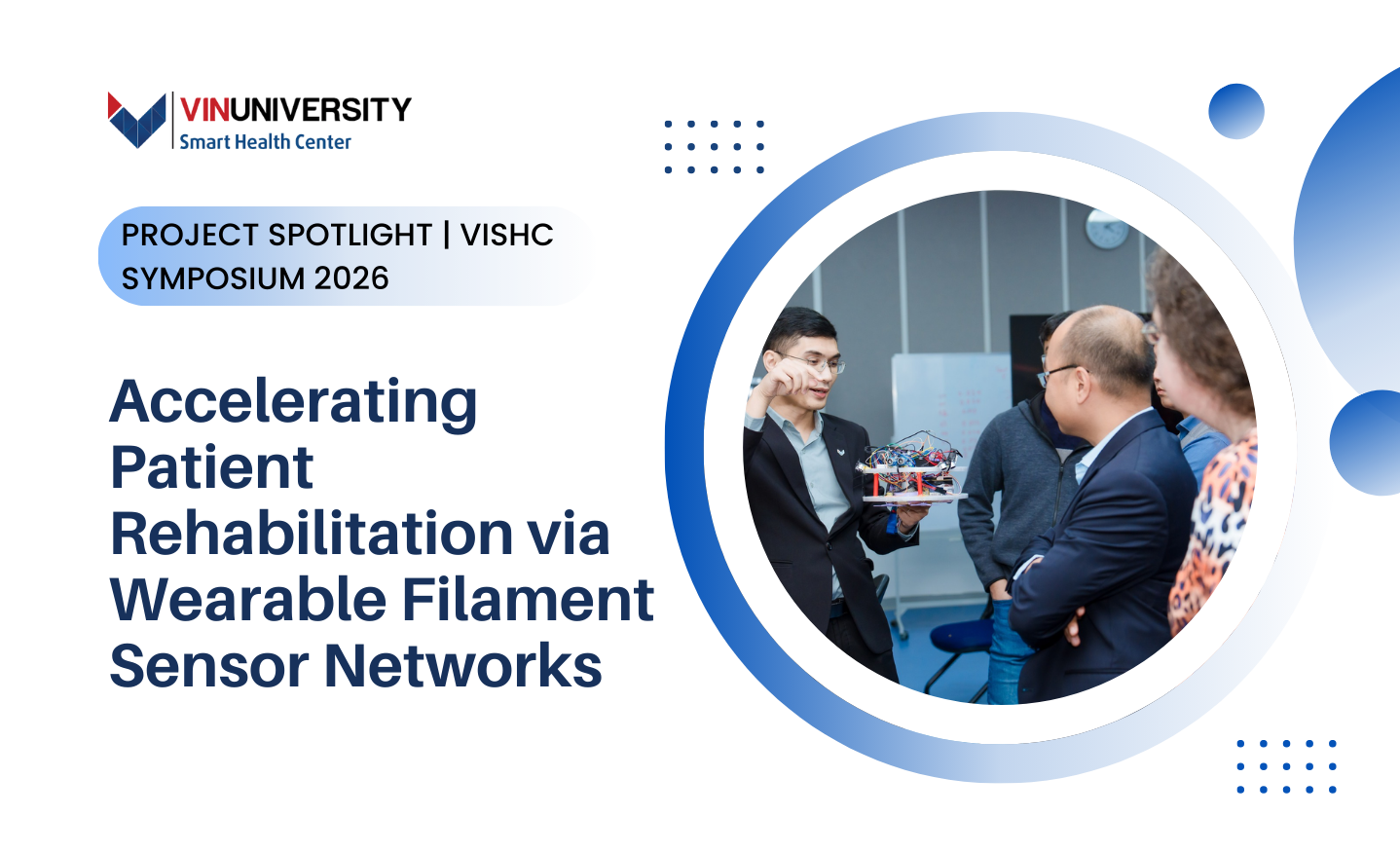
Accelerating Patient Rehabilitation via Wearable Filament Sensor Networks is a research project at the VinUni–Illinois Smart Health Center (VISHC). The project develops a low-cost wearable sensing system to support rehabilitation beyond hospital settings. By combining soft filament sensors with AI-based feedback, the system enables patients to rehabilitate at home while allowing clinicians to monitor movement quality and recovery progress remotely.
Key Principal Investigators & Members: Thai Mai Thanh, PhD | Phuong Cao, PhD | Elizabeth T Hsiao-Wecksler | Girish Krishnan, PhD | Craig Shultz, PhD The project was showcased at the Next-Gen Robotics Symposium 2026, co-organised with The University of Queensland. It exemplifies how next-generation robotics can move beyond laboratory demonstrations and address real healthcare challenges in accessible and scalable ways.
More broadly, the project raises a key question for the symposium: how can healthcare technologies be designed to work in everyday life, rather than only in controlled research environments?
Sports and movement-related injuries are becoming increasingly common, particularly knee injuries associated with activities such as pickleball, badminton, and basketball. Rehabilitation is essential for recovery, but it is only effective when exercises are performed regularly, correctly, and consistently over time.
In practice, many patients struggle to maintain rehabilitation routines. This is not due to a lack of awareness, but to structural and psychological barriers. Common reasons include:
As a result, clinicians often prescribe home-based exercises without the ability to monitor how well they are performed. Patients may exercise inconsistently, leading to slower recovery and suboptimal outcomes.
To address this gap, the project develops a wearable rehabilitation system based on soft robotics. Filament sensors are integrated directly into wearable supports such as knee braces, enabling continuous measurement during daily exercises.
Soft robotics uses flexible materials such as fabric, silicone, and rubber. Compared to traditional rigid mechanical systems, this approach is safer for human interaction, more comfortable to wear, and better suited to cost-sensitive healthcare settings. Although soft robotics is still relatively new in Vietnam, this project demonstrates how the field can be translated into practical clinical use.
By storing rehabilitation data over time, the system allows clinicians to move beyond self-reported compliance and make evidence-based decisions about recovery.
Supporting rehabilitation at home plays a critical role in improving outcomes. Many patients cannot attend frequent hospital visits due to time and cost constraints. Others feel more confident and comfortable exercising in familiar environments. When rehabilitation is effective and sustained, patients can return to daily life sooner, quality of life improves, and long-term pressure on healthcare systems is reduced.
From the early design stages, the team has worked closely with clinicians from Vinmec International Hospital, particularly those at the motion lab, to ensure alignment with real rehabilitation workflows. Before any human-subject studies are conducted, the project must undergo formal ethics approval. This process ensures patient safety, transparency, and scientific integrity. Importantly, the system is designed to support clinicians rather than replace them, and regular in-person consultations remain essential.
The project is led by Dr. Thái Mai Thành, Assistant Professor at the College of Engineering and Computer Science, VinUniversity. He joined VinUni in September 2023 after completing his PhD at the University of New South Wales.
Dr. Thành is the first PhD graduate of the Vingroup Scholarship Program to return to VinUni as a faculty member. His doctoral training in Australia helped him build long-term academic connections, which later enabled collaboration with partners such as the University of Queensland.
He leads the VinUni Biorobotics Lab (https://bioroboticslaboratory.com/), which focuses on soft robotics for medical applications, including rehabilitation, surgical support robotics, in-body biomaterial printing, and haptics for human–machine interaction. A defining feature of his work is a problem-first mindset. He emphasises that scientific research should create value for the community, while publications and academic recognition are secondary.
The project team includes doctoral researchers and students working across AI, electronics, and mechanical system design. In the future, the team aims to strengthen clinical involvement and incorporate expertise in technology transfer to move the solution closer to real-world deployment.
The project reflects VISHC’s interdisciplinary approach, integrating robotics, AI, clinical medicine, and international collaboration. At this stage, VISHC supports the project through funding for equipment, student scholarships, research infrastructure, and platforms such as the symposium that accelerate collaboration and visibility.
Collaboration with The University of Queensland strengthens the project by providing access to advanced research methods, shared expertise, and benchmarking against mature healthcare systems. These partnerships also create a foundation for future collaborative projects beyond a single device.
Over the next three to five years, the team aims to refine the technology, conduct human-subject studies, and progress toward a deployable product. The project’s future impact will depend on continued collaboration, clinical validation, and leadership within the research team. What remains clear is that rehabilitation robotics will only create meaningful impact when it is affordable, wearable, and clinically grounded.